What are we doing out here, anyway? For the last ten days we’ve been running these east-west transects, roughly 35 nautical miles long, surveying the area around the continental shelf break off the northern California coast. We headed south from San Francisco on July 5 to line 17, and we completed line 40 today, June 15.

The idea is to survey the Pacific hake population via sonar, then catch a sample to test the findings. The population data inform the management of this fish stock via the Pacific Whiting Treaty between the US and Canada. Eventually, if the acoustics can be proven to estimate the biomass accurately, the physical catch portion of this ongoing multi-year survey could be reduced or eliminated, and the fishery could be monitored and managed using sonar alone.
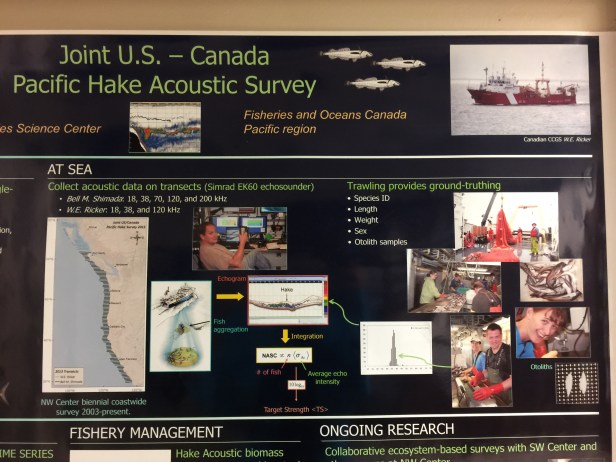

Acoustic visualizations look like this. Here you can see a school of hake in green/yellow/orange above the sea floor at 263 meters.
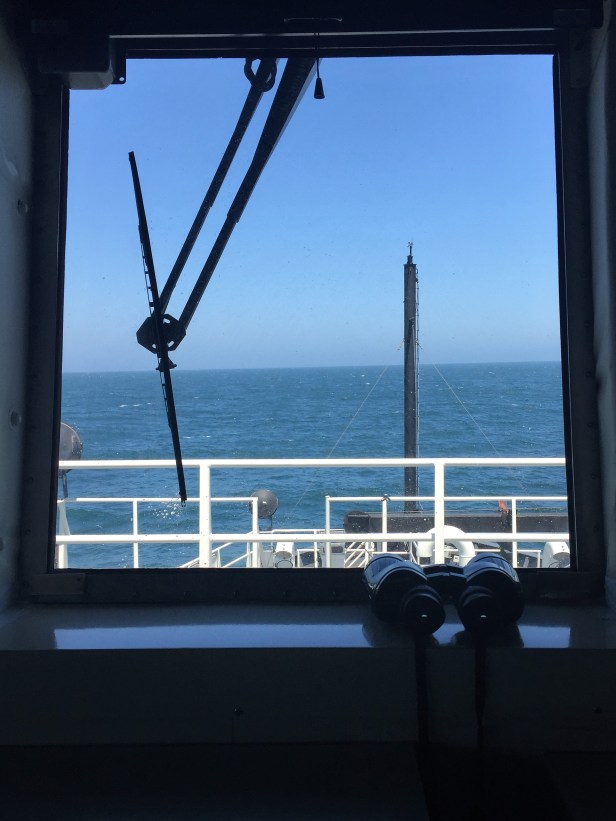
Before we fish, we watch for marine mammals for ten minutes. If we see any within 500 yards of the ship, we wait until they leave the area.
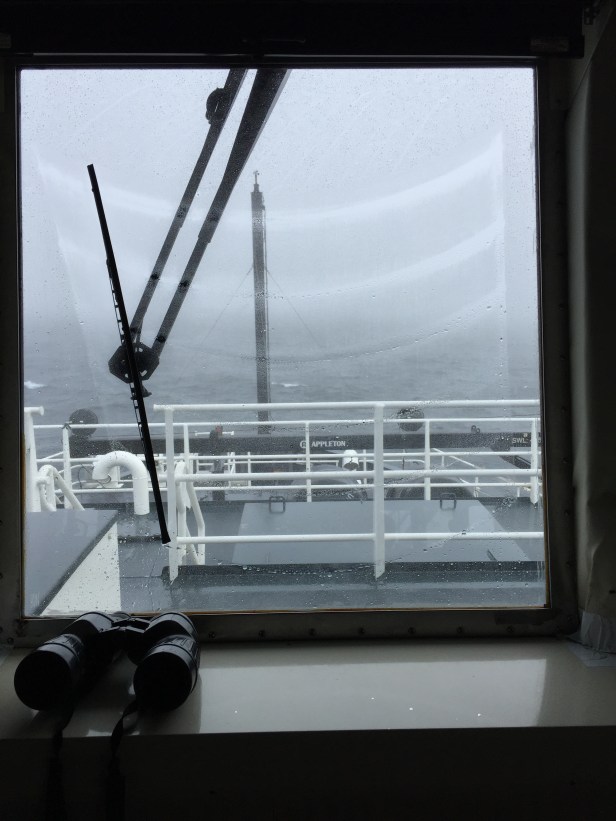
We do the marine mammal watch in the fog, too.
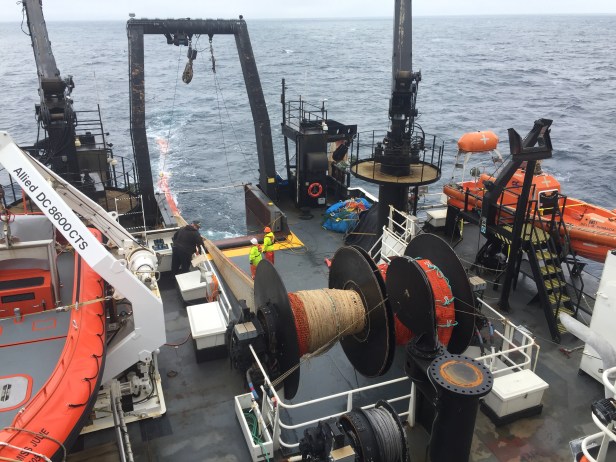
Finally, the net goes in the water.

The net is an AMAZING piece of equipment!
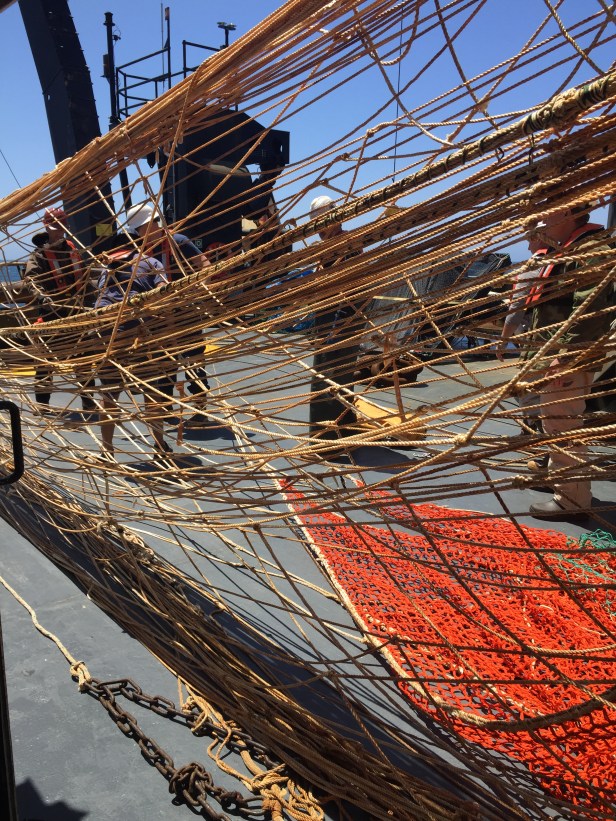
SO MUCH mesh of different colors and sizes rolls off the net reel.

And it’s not just the net in the water, we also attach a bunch of scientific instruments and other gear.

Like this underwater camera with LED lights. (We can’t see the video until we retrieve the camera.)
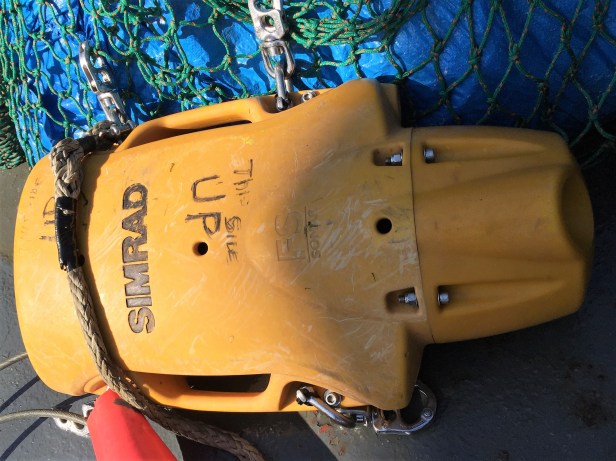
And this sonar transducer, which we call the turtle, that lets us monitor the net opening during fishing operations.

And these GIANT weights.
AND these enormous trawl doors, which fly like wings underwater to widen the net opening behind the boat.

This whole system, an Aleutian wing trawl, looks like this underwater. We usually fish between 200-400 meters deep, and as far as 800 meters behind the ship.
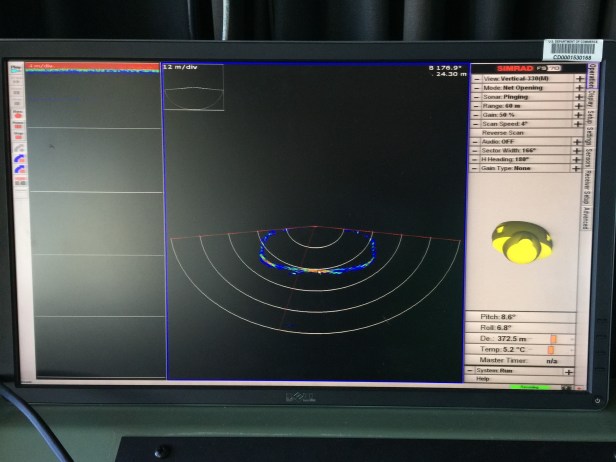
Here’s the view of the net opening from the turtle…I find it amazing that blips on this screen are actually fish entering the net.
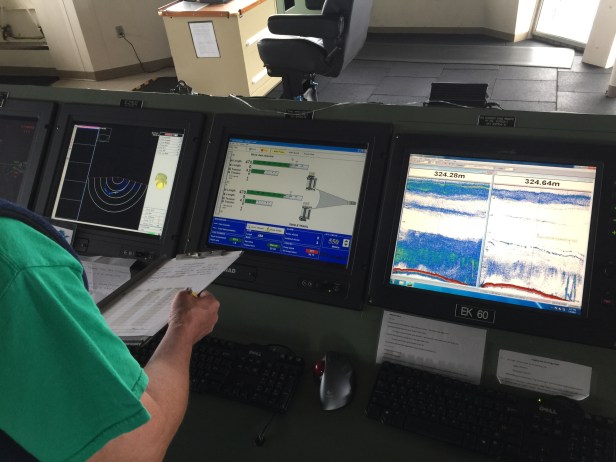
From the bridge we adjust the depth of the net to match the schools of hake we see on the sonar.

Deck crew members control the three winches from here, at the back of the bridge, constantly communicating with the officers driving the ship.

You can’t see them in this photo, but sea birds often gather and wait to see what we catch.
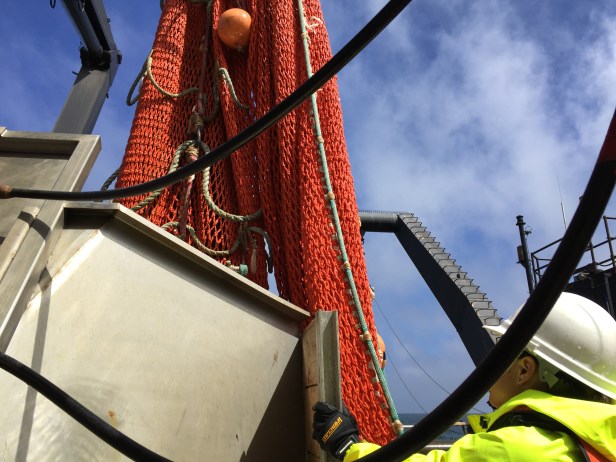
We usually trawl for 20-40 minutes, intentionally catching only enough fish for our sample, ideally around 400 fish.
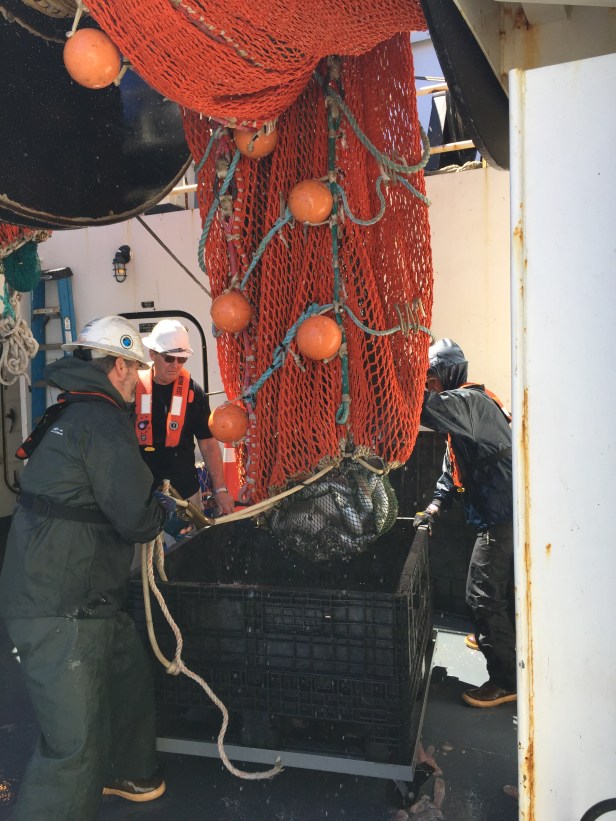
On deck, we wait to see what’s in the net. The acoustics are so reliable that it’s usually almost entirely hake…but there have been some awesome surprises too!
Stay tuned for more photos from the fish lab, including the work we’re doing with the hake, and some of the other weird things we’ve discovered in the ocean!
 Spindrift