The National Marine Mammal Health and Stranding Response Program coordinates emergency responses to sick, injured, distressed, or dead marine mammals. Five regional Marine Mammal Stranding Networks accept reports from the public and respond accordingly: New England/Mid-Atlantic, Southeast, West Coast, Alaska, and Pacific Islands. Regional networks include government agencies, universities, nonprofit organizations, and emergency responders. Each network member has unique capabilities and resources to contribute to a response effort: from scientific data collection and analysis, to crowd or traffic control, to rescue and rehabilitation services.
Some regions, like Oregon, do not have facilities for rescue and rehab, but the network will still respond to assist a stranded or entangled animal if possible. In Central California, The Marine Mammal Center (TMMC) is uniquely able to rescue and respond directly to strandings of smaller marine mammals, transporting sick and injured seals and sea lions to its main hospital in Sausalito. But a response effort for an entagled large whale is a unique and relatively new capability, and there are not many people who are qualified or authorized to conduct a whale disentanglement operation.
On Sunday, I was lucky enough to attend a TMMC volunteer seminar with Pieter Folkens, illustrator of the amazing field guide to Marine Mammals of the World. Pieter is one of only a few advanced primary reponders in California. I was surprised to learn that most of the techniques and equipment have been developed in the field relatively recently, as the number of reported large whale entanglements has begun to rise consistently each year.
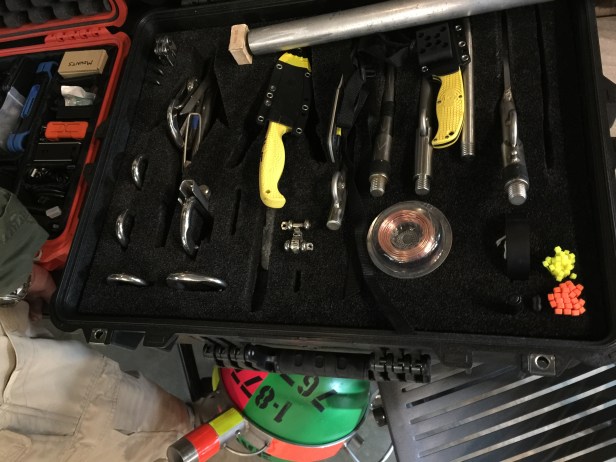
The disentanglement operation—when a group of responders finally approaches the whale in a small vessel with tools to remove the entanglement—is actually part of a much more comprehensive effort by a larger group of volunteers, researchers, and government officials.
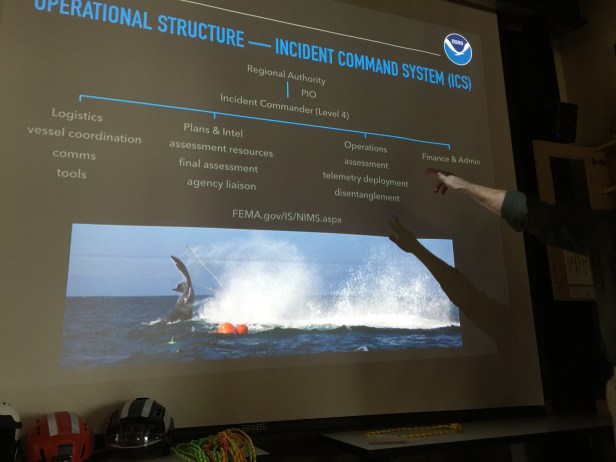
A typical response effort could take days or weeks, as the network mobilizes the people, vessels, and other resources needed for a successful operation.

Often, entangled whales disappear from sight and may be lost before responders can even begin the rescue effort. In a story featured on ABC’s series Sea Rescue (Season 4, Episode 1, Beyond the Call), the disentanglement team tracked a whale off the coast of California for more than two weeks before conditions were safe enough for a rescue attempt.
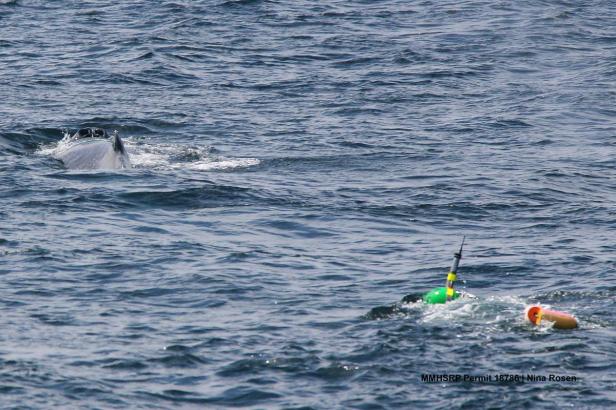
Visit the California Whale Rescue website for more photos and video.


Watch some NOAA footage of large whale disentanglements to see disentanglement teams in action.
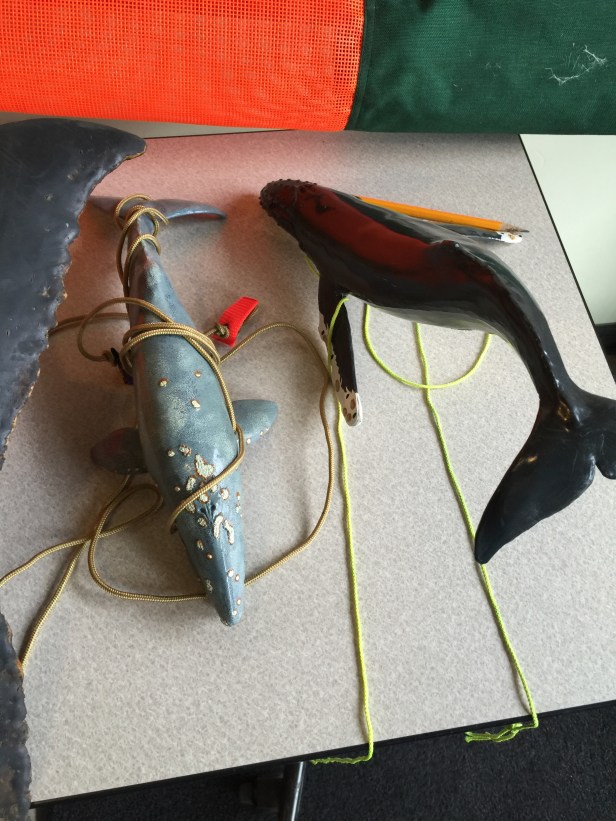
If you witness an entangled large whale, please call your regional hotline:
- Atlantic and Gulf Coasts – (866) 755-6622
- California, Oregon, and Washington – (877) SOS-WHALe (877-767-9425)
- Alaska – (877) 925-7773
- Hawaii – (888) 256-9840
or hail the US Coast Guard on VHF channel 16. You can help by communicating the whale’s location in latitude and longitude (learn how), describing the entanglement or sharing photos, and staying with the whale until help arrives, if possible.
There is also an app for this: Dolphin & Whale 911.
If you live or work on the ocean or near shore, and you would like to volunteer help report, track, or disentangle large whales in distress, please contact a Marine Mammal Stranding Network member in your area.


 Spindrift